





Menu
The menu, located at the top right corner of the software, contains several items allowing you to access different features.
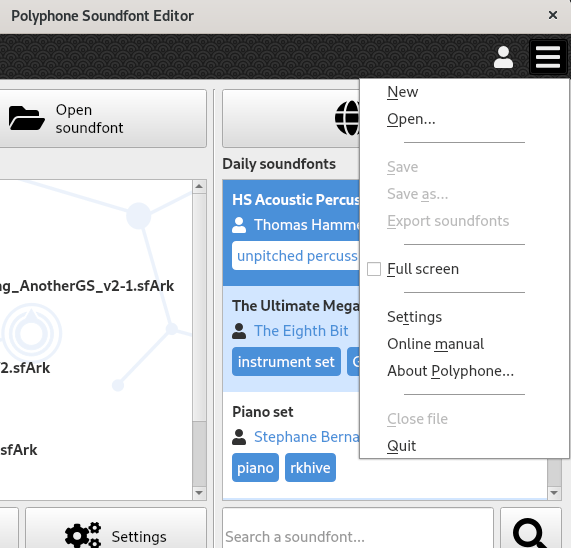
Opening a soundfont editor
- New
- Create a new empty soundfont, everything having to be done from scratch. Also accessible with the shortcut Ctrl+N.
- Open…
- Open an .sf2, .sf3, .sfz, .dls, .sfArk or .organ file. Also accessible with the shortcut Ctrl+O.
Saving a soundfont
- Save
- Save the current file. Also accessible with the shortcut Ctrl+S.
- Save as…
- Save the current file in another file. Also accessible with the shortcut Ctrl+Shift+S.
- Export soundfonts…
- Merge and export one or several presets from the open soundfonts in the .sf2, .sf3, .sfz or .dls format. The additional .csv format exports all parameters for a detailed analysis of the soundfont content. Also accessible with the shortcut Ctrl+E.
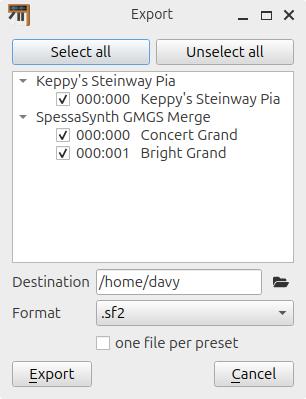
In the export window, the presets of all open soundfonts are listed and the ones to export must be ticked (the buttons Select all and Unselect all help to quickly change the selection). The field above these buttons filters the list on the preset numbers and names (shortcut Ctrl+F, the keys ↓ or Enter then going to the first preset displayed): both buttons only apply to the presets displayed, and the ticked presets hidden by the filter are still exported. Several presets can be selected by maintaining the key Ctrl and clicking on them one by one, or with the key Shift for selecting all presets between two clicks. The key Space then ticks or unticks them together. A double click anywhere on the row of a preset also ticks or unticks it. The number of ticked presets is displayed under the list, along with the number of those hidden by the filter. The other parameters are:
- Destination
- The directory in which the files are written. A file is never overwritten: if a file with the same name already exists, a number is added at the end of the name of the new file.
- Format
- One of .sf2, .sf3, .sfz, .csv or .dls. If the presets come from several soundfonts, they are merged into a single soundfont in which each source soundfont becomes a bank. This is why a maximum of 127 soundfonts, each of them with a maximum of 127 selected presets, can be exported at the same time.
- Quality
- For the .sf3 format only, quality of the compression of the samples.
- One file per preset
- For the .sf2, .sf3 and .dls formats only, creation of one file per selected preset instead of a single file.
- One directory per bank, preset number as prefix, General MIDI classification
- For the .sfz format only. The export creates a directory containing the sfz files and a sub-directory samples. The sfz files can be put in one directory per bank, their name can be prefixed with the preset number, and they can be sorted into directories corresponding to the General MIDI categories.
- Raw values
- For the .csv format only. The values are written as they are stored in the sf2 format, instead of being converted into usual units (seconds, decibels, cents, etc.). The export creates a directory containing the file samples.csv and one file per instrument and per preset.
View options
- Full screen
- Toggle the full screen mode. Also accessible with the shortcut F11.
Shortcuts
- Settings
- Open the software settings. Also accessible with the shortcut Ctrl+,.
- Online manual
- Show this user manual in a web browser. Also accessible with the shortcut F1.
- About Polyphone…
- Show the software version and the copyright. The button Credit shows the list of people who contributed to the project.
Closing
- Close tab
- Close the current tab (a soundfont editor, a soundfont explorer, the settings, etc.). Also accessible with the shortcut Ctrl+W.
- Quit
- Quit the software. Also accessible with the shortcut Ctrl+Q.
Polyphone is free but there are costs associated with its website and development. A small donation will help a lot.
Donatetop