





About Polyphone
Polyphone is a free and open-source editor of soundfonts (files containing virtual instruments) for Windows, macOS and Linux. It turns recordings into playable musical instruments: a concert piano, a gospel choir, a distorted electric guitar, an 8-bit game console, a gamelan or a whole symphony orchestra. It also exists as a plugin for digital audio workstations, which plays these instruments in music projects with the same sound engine.
Born in 2013, the project comes with a website that brings together its documentation, its forum and a repository of soundfonts shared by the community.
- 13years of development
- 27versions released
- 16languages
- 20,000downloads per month from this website
- 2,000soundfonts in the repository
Where it started
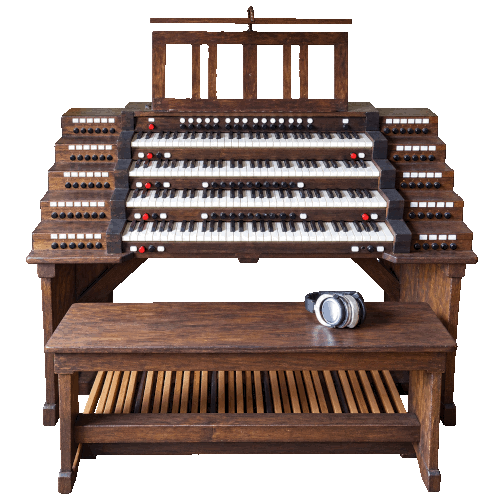
It all began with the challenge of a pipe organ and computer music enthusiast: playing this monumental instrument at home, with sounds generated by a computer. Soundfonts were the obvious choice: free, widespread, and able to reproduce an instrument faithfully from recordings, here those of its pipes. They are also an excellent teaching tool for learning audio synthesis: envelopes, filters, loops and modulations can be set and heard right away.
Those sounds still had to be prepared. This instrument is comparable to a whole orchestra, and voicing its pipes by changing parameters one at a time was far too tedious with the editors of the time. So the idea was to write the missing tool, able to process many samples and instruments at once.
The tool then served many other instruments, but the organ was not forgotten: Polyphone still includes tools for creating mixtures, spatializing sounds and detuning that make it easier to create and edit an organ. It can also create soundfonts from the dispositions of GrandOrgue, a virtual organ program.
Milestones
- 2013
First website and first version of the software in January, published so that everyone can enjoy them. Version 1.0 in September, then arrival on macOS at the end of the year.
- 2016
Second website, with a forum and the documentation.
- 2017
Opening of the online soundfont repository: years of creations, until then scattered all over the web, are archived there, and a detailed classification makes it easier to find an instrument.
- 2018
Members can share their own soundfonts, and version 2.0 opens the repository directly in the software.
- 2024
Third website, this one, with a new logo, user ranks and private messages. Version 2.4 makes Polyphone a complete synthesizer, which can even be embedded in an instrument, for example with a Raspberry Pi.
- 2025
Soundfont reviews by experienced members, to help the authors improve their work.
- 2026
Version 2.6, with a soundfont explorer and a new handling of compressed samples. Then a plugin brings the sound engine of Polyphone into the digital audio workstations.
A community around Polyphone
Polyphone moves forward thanks to its users. They test the new versions, report bugs and suggest ideas on the forum or on GitHub, where the source code is public, and some occasionally lend a hand with the development. Others translate the software into their language, and the progress of each translation can be seen on the website.
The soundfont repository relies on the same mutual help: members share their instruments there, comment on them, rate them, and the most experienced ones review them. The website rules describe how these exchanges work.
An independent project
Polyphone is free software, licensed under the GNU General Public License, and free of charge. The website shows no advertising: donations and Premium accounts pay for the hosting, the creation of the installers for each system and the updates of the software. A Premium account, paid once, gives unlimited downloads and access to the whole repository from the software.
Who is behind Polyphone?

I have always loved music and wanted to understand how a sound is made. This gave me an idea that was a little too ambitious: an organ at home, without the pipes.
To get there, I had to learn. While my career was taking me from biotechnology to computing, I made Polyphone my school of programming, signal processing and audio synthesis. I progress by experimenting: I try, I listen, I start again.
Out of these experiments came a piece of software, then a website to share it, which I have developed since 2013 in my spare time, sometimes helped by contributors. The initial idea became reality: my organ console still sounds wonderful and transports me every time I sit down at it, while Polyphone is available to everyone.
My conviction: we learn by trying, we progress by building, and we flourish by sharing.
Polyphone is free but there are costs associated with its website and development. A small donation will help a lot.
Donatetop